
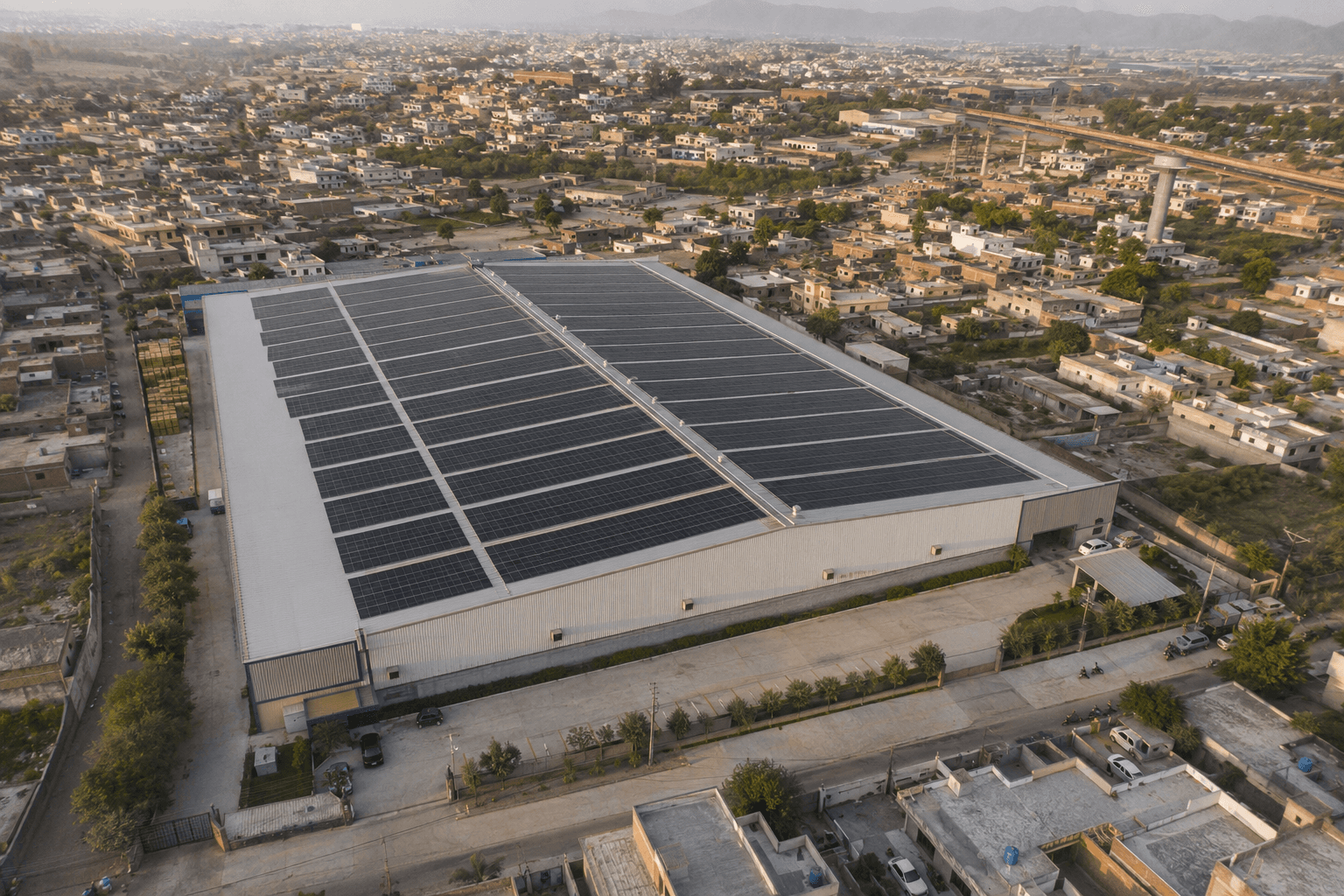
Most of what we write about lives close to home, because the Canadian market is where the work actually gets done. This week we want to step back and look wider. Solar is one of the few things nearly every country on earth is moving toward at the same time, and the scale of it is hard to picture. The world crossed roughly 2,383 GW of installed solar by the end of 2025, and capacity has been doubling every two to three years since 2018. Look closer at any single country, though, and the reason behind its boom is almost never the same as its neighbour's. The growth is global. The story behind it is local, every time.
Who Is Actually Buying, and Why?
Commercial buyers are not making an emotional decision about clean energy. They are looking at a line on an operating statement. Businesses with high daytime electricity use, warehouses, manufacturing, cold storage, agricultural operations, are the ones where the numbers work most cleanly, because their consumption lines up with when panels produce. When a building draws heavily through the working day, more of what the system generates gets used on site rather than exported, and that changes the return.
That shift in buyer logic is the first thing to absorb. A homeowner asks what it costs and how long until it pays back. A business owner is running the same math their accountant runs on any capital purchase, weighing it against other uses for the money. Rising and volatile electricity costs have made that comparison land differently than it used to, and for operations exposed to large power bills, generating on site starts to look like a hedge rather than an upgrade.
Pakistan Built a Boom With No Program at All
Pakistan is the clearest example of solar growth that no government engineered. By the summer of 2025, solar had become the country's single largest source of electricity, generating around a quarter of the national total, and almost none of it came from a national scheme or a feed-in tariff.
It came from people. Households and businesses tired of unreliable supply and rising bills bought panels and put them up themselves. Pakistan imported roughly 17 GW of solar panels in 2024 alone, making it one of the largest destinations for Chinese-made modules in the world that year, and most of that capacity sits on rooftops behind the meter where no central body is fully tracking it. Affordable, reliable equipment reaching the market at scale is what made a grassroots build-out like that possible.
Saudi Arabia Is Doing the Exact Opposite
Move west to Saudi Arabia and the same technology is being deployed in a completely inverted way. There is very little rooftop story here. The Saudi boom is state-run, utility-scale, and built around enormous desert installations.
The country's Al Shuaibah 2 plant near Jeddah runs to more than 2 GW on its own, and in a single 2025 procurement round developers signed agreements covering 15 GW of new solar capacity, all tied to a national target of half the country's electricity from renewables by 2030. One country grew its solar from the rooftop up with no plan. The other is building it from the top down as national policy. Same panels, opposite machines.
Germany Built the Machine Everyone Else Runs On
Germany's boom is older than either, and in a sense it made the others possible. It ran the world's first national feed-in tariff, and by the late 2000s its annual installations accounted for close to a third of all solar going in worldwide. That early, deliberate investment is widely credited with driving down the cost of solar technology globally.
Two decades on, Germany is a mature market rather than an explosive one. It still added 16.9 GW in 2024 and crossed 100 GW of cumulative capacity, but the policy conversation has shifted toward winding back subsidies now that the technology can stand largely on its own. The cheap, proven panels showing up on rooftops in Pakistan trace part of their lineage back to what Germany paid to build first.
Why the Local Story Is the Only One That Matters
Three countries, three completely different engines. And the pattern holds everywhere else too. Türkiye's growth runs off its energy-import position, Europe's broader re-acceleration traces back to the gas shock, and the United States is contending with policy that keeps shifting underneath the industry. There is no single global reason solar is booming, because each market is answering its own pressures.
Canada is no different. Our growth is shaped by hydro's changing position, provincial procurement rounds, and net metering rules that vary from one province to the next. Those are the forces actually driving demand here, and they look nothing like what is driving it in Pakistan or Saudi Arabia. Reading the Canadian market through somebody else's boom would tell you very little about the job in front of you.
The worldwide numbers are useful for perspective. The country you are actually installing in is the only one that changes how you quote a system next week. Knowing your own market cold, right down to the province, is what the global picture ends up asking of you.
If you ever want to talk through how the Canadian side of that picture is shaping up, say hi.